The quick answer
| Day | Mysteries |
|---|---|
| Sunday | Glorious |
| Monday | Joyful |
| Tuesday | Sorrowful |
| Wednesday | Glorious |
| Thursday | Luminous |
| Friday | Sorrowful |
| Saturday | Joyful |
One set is five mysteries, one per decade. Praying today's set is what most people mean by "praying the rosary."
How Thursday became Luminous
For centuries the rosary had fifteen mysteries: Joyful, Sorrowful and Glorious. In October 2002, Pope John Paul II published the apostolic letter Rosarium Virginis Mariae, which proposed five new ones from the public life of Jesus, which he called the Mysteries of Light, or Luminous Mysteries (no. 21).
Five new mysteries needed a day. Under the older custom, Monday and Thursday were both Joyful. The letter (no. 38) suggested moving the second Joyful day to Saturday, which freed Thursday for the Luminous Mysteries. Tuesday and Friday stayed Sorrowful; Wednesday and Sunday stayed Glorious.
The same paragraph adds an important note: this weekly pattern is a suggestion, not a rule. Its purpose is to give each day its own character, the way the liturgical year gives each season one.
The twenty mysteries, with where to read them
The Gospel references below are the passages usually read with each mystery.
Joyful Mysteries: Monday and Saturday
- The Annunciation (Luke 1:26-38)
- The Visitation (Luke 1:39-56)
- The Nativity of our Lord (Luke 2:1-20)
- The Presentation in the Temple (Luke 2:22-38)
- The Finding of Jesus in the Temple (Luke 2:41-52)
Luminous Mysteries: Thursday
- The Baptism of Jesus in the Jordan (Matthew 3:13-17)
- The Wedding at Cana (John 2:1-11)
- The Proclamation of the Kingdom of God (Mark 1:14-15)
- The Transfiguration (Matthew 17:1-8)
- The Institution of the Eucharist (Matthew 26:26-28)
Sorrowful Mysteries: Tuesday and Friday
- The Agony in the Garden (Matthew 26:36-46)
- The Scourging at the Pillar (John 19:1)
- The Crowning with Thorns (Matthew 27:27-31)
- The Carrying of the Cross (John 19:16-17)
- The Crucifixion and Death of our Lord (Luke 23:33-46)
Glorious Mysteries: Wednesday and Sunday
- The Resurrection (Luke 24:1-12)
- The Ascension (Acts 1:6-11)
- The Descent of the Holy Spirit (Acts 2:1-4)
- The Assumption of Mary, defined as a dogma by Pius XII in 1950
- The Coronation of Mary as Queen of Heaven and Earth, often prayed with Revelation 12:1
Questions people ask about the schedule
Is there a different schedule for Lent?
Not in Rosarium Virginis Mariae: the letter doesn't change the weekly pattern for Lent, Advent or Christmas. Some parishes and families keep their own customs for those seasons, such as favoring the Sorrowful Mysteries in Lent. If you pray with a group, follow what they do; if you pray alone, the weekday pattern is always a safe choice.
Which mysteries do I pray on Christmas Day?
Christmas falls on a different weekday each year, and the weekly pattern doesn't make an exception for it. Many people choose the Joyful Mysteries that day because they include the Nativity. Either way is fine.
What if I prayed the wrong set?
Nothing is lost. The letter itself describes the schedule as an aid, and some people choose a set for the occasion that brings them together. That's just as valid.
Do I have to pray all twenty?
No. One set of five a day is the usual practice. Praying all twenty is a longer devotion some people keep, for example during a novena.
How is each mystery announced?
The usual way is the number and the name: "The first Joyful Mystery, the Annunciation." Then come the Our Father, ten Hail Marys and the Glory Be. Many people add the Fatima prayer after the Glory Be: "O my Jesus, forgive us our sins, save us from the fires of hell, lead all souls to heaven, especially those in most need of thy mercy."
Can I pray without rosary beads?
Yes. The beads are a way to keep count, not a requirement. You can count on your fingers, use a one-decade ring, or follow along with an app that tracks each Hail Mary for you.
How long does one set take?
Around twenty minutes at a steady pace, a bit longer if you add the Hail Holy Queen, the Litany of Loreto or a pause to reflect on each mystery.
How the app handles it
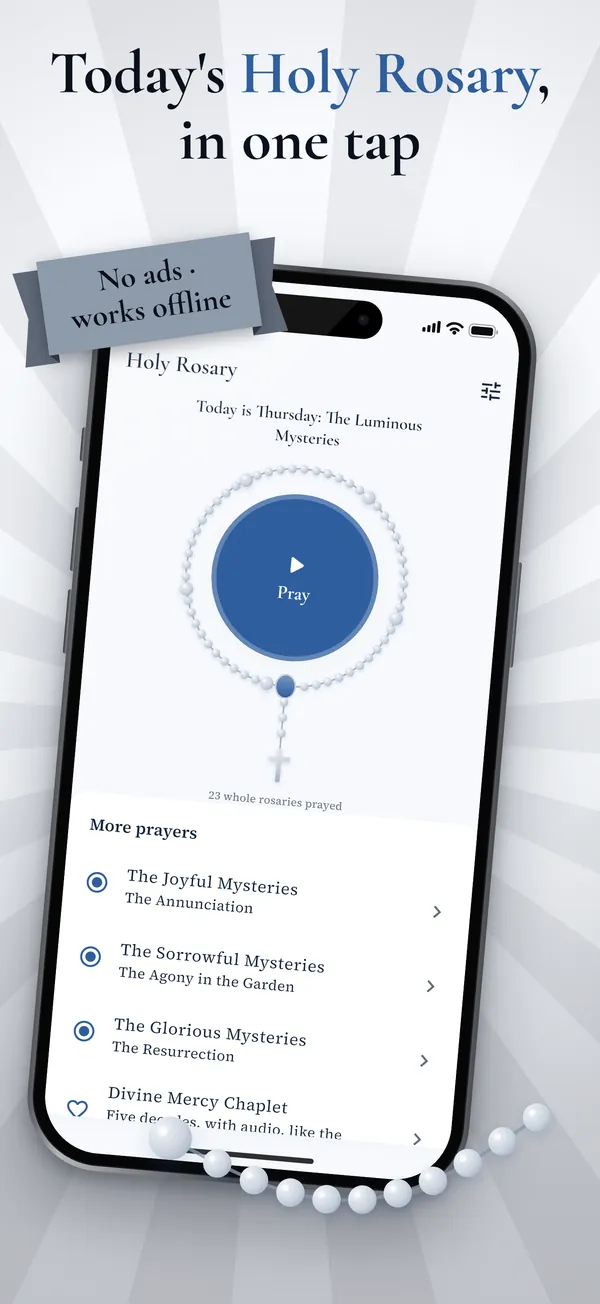
Our app opens on today's mysteries, with the weekday and the name of the set, and starts with one tap. If you want a different set, you pick it on the same screen, at no cost. Each mystery is announced by name, and the current prayer appears in large print while the beads move.
You can switch on a pause to reflect on each mystery and choose which prayers to include: the Apostles' or Nicene Creed, the Fatima prayer, the Hail Holy Queen, the Litany of Loreto, the prayer for the Pope's intentions and a closing prayer. A Latin text option is there too, read silently because the voice doesn't speak Latin.
Praying all 20 mysteries in a row is part of the paid tier.
Keep reading
Planning a longer devotion? The 54-day Pompeii novena explains how it's structured. Choosing an app? Read our rosary app comparison, where the apps are ordered by how recently they were updated, or go straight to our app.