Your doctor says: "Check your blood pressure at home for a week and bring me the numbers." Most people come back with a scrap of paper or a dozen photos of the monitor's screen. A good log takes the same effort and saves your appointment from turning into a puzzle.
What the routine looks like
The American Heart Association's home monitoring guidance asks you to:
- Measure at the same time every day.
- Take two readings, one minute apart, each time you measure.
- Avoid smoking, caffeine and exercise for 30 minutes before.
- Rest quietly for five minutes first, back supported, feet flat, arm resting at heart level, cuff on bare skin.
- Record every result and bring the log (or the monitor, if it stores readings) to your appointments.
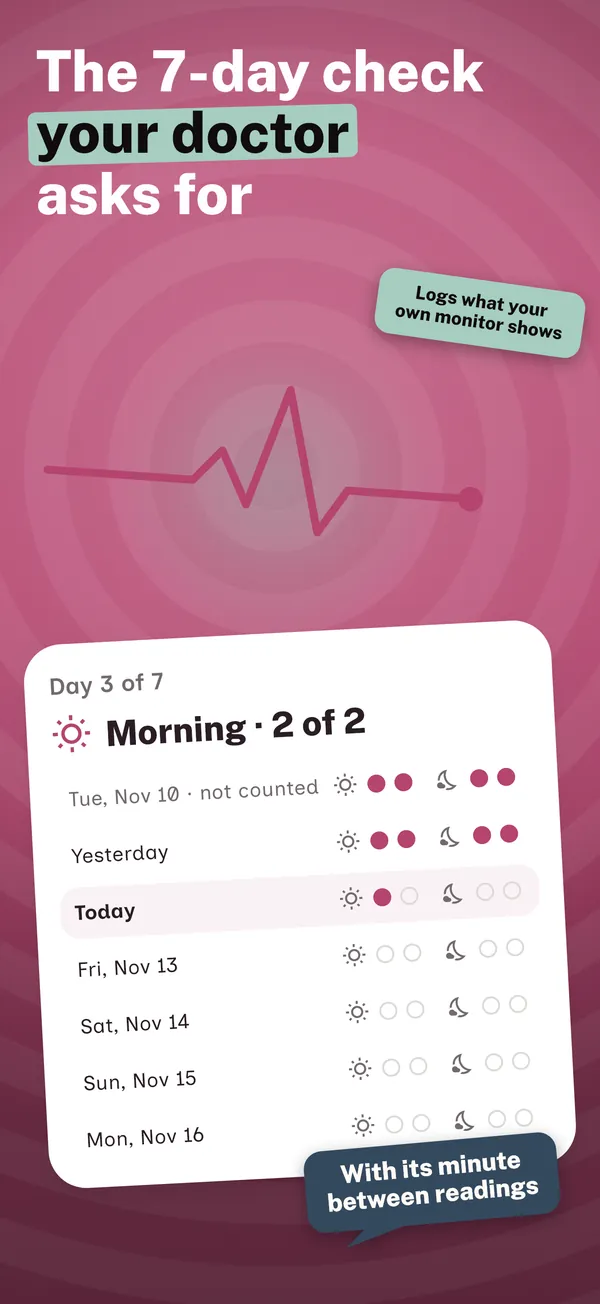
When the goal is to check your blood pressure over a week, for example before a diagnosis or a change in medication, the European Society of Hypertension spells out the schedule: seven days (at least three), morning and evening, two readings each time, and the first day left out of the average.
How often you measure after that is a question for your clinician.
The columns that matter
| Column | Why your doctor wants it |
|---|---|
| Date | To see the pattern across the week |
| Time | Morning and evening readings can differ |
| Reading 1 (top/bottom) | Systolic and diastolic, as shown |
| Reading 2 (top/bottom) | One minute later; together they smooth out a fluke |
| Pulse | Most monitors show it anyway |
| Arm | Readings can differ between arms; stick to one |
| Before or after medication | Morning readings are usually taken before |
| Notes | Bad night, pain, stress, a missed dose, a new medicine |
A sheet you can copy
| Day | Date | Morning 1 | Morning 2 | Evening 1 | Evening 2 | Notes |
|---|---|---|---|---|---|---|
| 1 (practice day) | / | / | / | / | ||
| 2 | / | / | / | / | ||
| 3 | / | / | / | / | ||
| 4 | / | / | / | / | ||
| 5 | / | / | / | / | ||
| 6 | / | / | / | / | ||
| 7 | / | / | / | / |
Write the top number, a slash, the bottom number, and the pulse in brackets if you want it. Leave a box empty rather than guessing a reading you missed.
Filling it in without bias
- Write down both readings, even if the second looks "better." Picking the nicer one skews the average.
- Don't re-measure until you like the result. Two readings, one minute apart, done.
- Don't add extra readings on days you feel off. Note how you felt instead.
- Use the same arm each time, the one your clinician suggests.
Turning it into averages
- Leave out day 1, if you're following the European schedule.
- Add all the top numbers from the remaining days and divide by how many readings there are. Do the same for the bottom numbers.
- If your doctor asks, do it separately for mornings and evenings.
Over six full days, that's 24 readings. Single readings vary a lot; the average is what gets compared with guideline thresholds, and that comparison is your clinician's job.
What to bring along with the sheet
The log is the main thing, but a few extras make the conversation shorter:
- Your monitor. The AHA suggests having your clinician check that it reads the same as the office equipment, about once a year or as the manufacturer recommends.
- A list of what you take, with names, including over-the-counter medicines and supplements. Some of them can affect blood pressure.
- The questions you want answered, written down. In a short appointment it's easy to forget the one that worried you most.
- Anything unusual during the week, like a cold, a long flight or a very bad night, if you didn't already note it.
Paper or app?
Paper works and never runs out of battery. Its weak points are the math, the reminders and the minute between readings, which people tend to skip. That's where an app helps.
Ours, Blood Pressure Log: Large Text, is built around this exact week:
- Pick 3 to 7 days (7 by default) and the times for the morning and evening reminders.
- It tells you what's next: morning or evening, first or second reading.
- It counts down the minute between the first and second reading.
- It leaves day 1 out when the chosen guideline says so, and you can change that if your doctor tells you otherwise.
- At the end, morning, evening and overall averages, shown next to the home reference value of the guideline you pick (AHA/ACC 2025 by default in the US) and your doctor's target, if you entered one.
- A one-page PDF with each day's readings and the averages, ready to email or print. The week and its PDF are free; longer reports and full history are part of the paid tier ($12.99 a year after a free month, or $19.99 to keep for good).
It doesn't measure anything. You take your reading with your cuff and type it in with large keys. Nothing to sign up for, and the readings never leave your phone unless you share the PDF.
Keep reading
Wondering about those apps that "measure" with your finger? Read whether your phone can measure blood pressure. Comparing apps? See our Android blood pressure app comparison. Screenshots and details: Blood Pressure Log: Large Text.