Losing count usually happens the same way: you finish a row, reach for your drink, someone asks you a question, and when you pick the hook back up you're not sure whether you just finished row 14 or are still on it. The fix isn't more willpower. It's picking a counting method that matches the project in your lap.
Start with the question: what are you counting?
Most crochet projects ask you to track one of three things, and sometimes two at once:
- Rows or rounds (how far up the piece you are);
- Stitches within a row (especially on increase rounds);
- Repeats of a stitch pattern (every 4 rows, every 8 rounds).
One number is easy. Two numbers at the same time is where people slip, so keep that in mind as you read the options below.
Option 1: tally marks on the printout
The classic. A pencil stroke in the margin at the end of every row.
Good for: short, flat projects worked in rows, like a scarf panel or a dishcloth, where a mistake costs you one row of frogging at most.
Watch out for: you have to set the hook down every single row, the pattern fills up with marks, and a missing mark is invisible. Paper never tells you that you forgot.
Option 2: stitch markers
A locking stitch marker clipped into the first stitch of the round, moved up every time you get back to it.
Good for: anything worked in a spiral, like amigurumi, hats and coasters. Without a marker you genuinely can't tell where a spiral round begins.
Watch out for: a marker tells you where the round starts, not how many rounds you've done. Hang a second marker every 10 rounds if you want to count back by eye.
Option 3: a clicker or ring counter
The little plastic tally counter you click with your thumb, or the ring kind worn on a finger.
Good for: keeping your hands near the work. It's cheap, it never needs charging, and it lives in your project bag.
Watch out for: double clicks and missed clicks are easy and there's no undo. It counts one thing, so rows and repeats means two clickers and remembering which is which.
Option 4: counting the fabric
Rows of single crochet show as clear "V"s; amigurumi rounds form rings around the magic ring.
Good for: checking. It's the only method that looks at what you actually made.
Watch out for: it's slow, and it's hard with dark, fuzzy or very fine yarn. Use it every 10 rows to confirm your count, not as the count itself.
Option 5: a row counter app
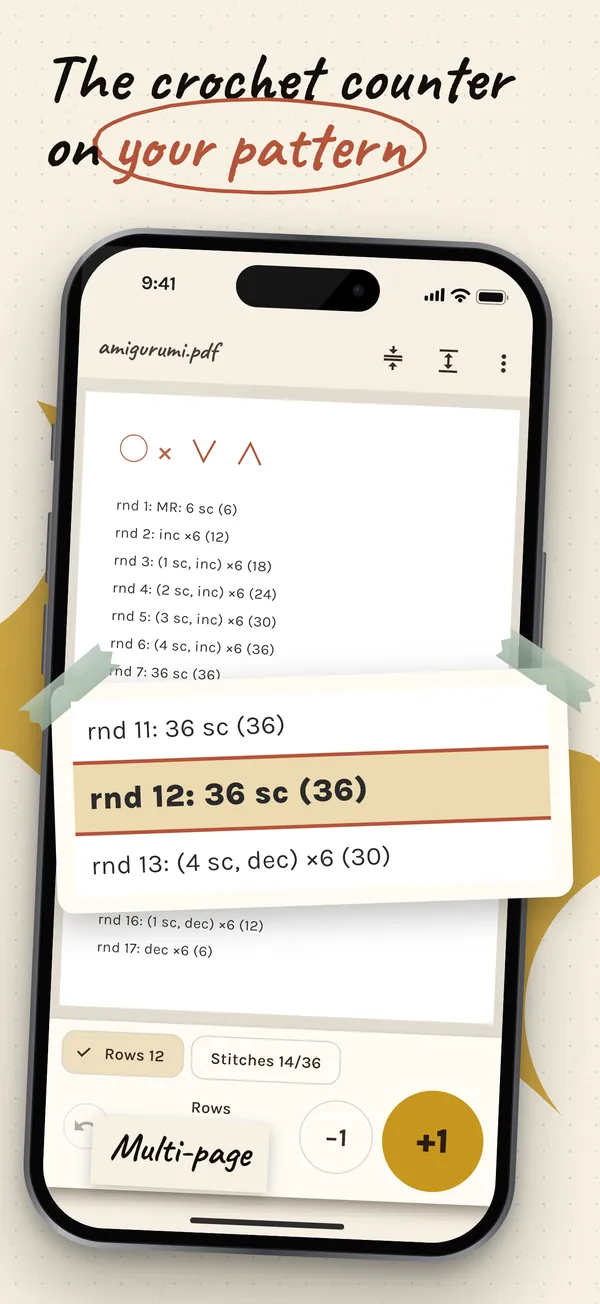
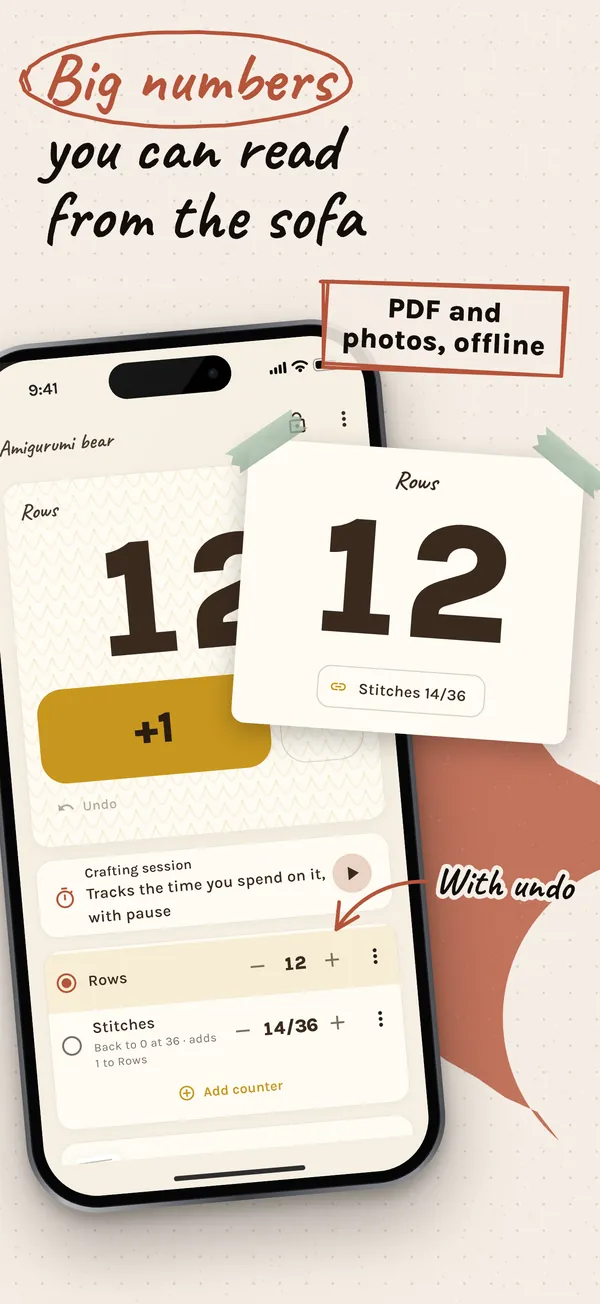
Your phone is already next to you. A good counter app adds what a clicker can't: undo, several counters at once, and each project remembering where it stopped.
What separates a helpful one from an annoying one:
- Can you count without letting go of the hook? A huge button helps; counting with the phone's volume buttons helps more.
- Is the counter where the pattern is? Jumping between a PDF viewer and a counter app is exactly when rows go missing.
- Does it stay out of the way? Full-screen ads every few rows, or a rating prompt every time you open it, break the rhythm you need to count.
The method by project
| Project | What to count | Best combo |
|---|---|---|
| Dishcloth, scarf in rows | Rows | Tally marks or one counter |
| Amigurumi, hats in the round | Rounds + stitches on increases | Start-of-round marker + two linked counters |
| Granny squares | Rounds per square, squares done | One counter per square, one for the total |
| Corner-to-corner blanket | Rows, and whether you're increasing or decreasing | Counter + the row highlighted on your chart |
| Anything from a PDF chart | Which chart line you're on | A counter tied to a row marker on the chart |
Linked counters: the trick for two numbers
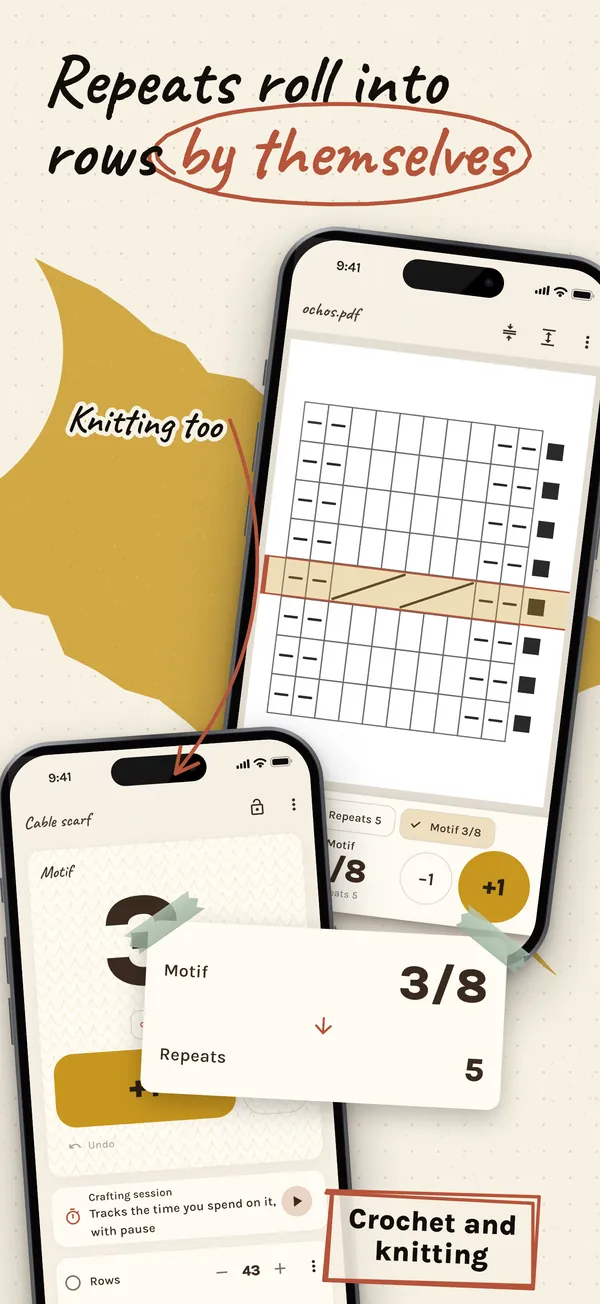
When you need stitches and rounds at once, link them: give the stitch counter a limit (say 36) and connect it to the round counter. When stitches hit 36, they reset to 0 and the round goes up by one. You only ever tap one counter.
The same idea works for repeats: an 8-row pattern repeat that adds one to a "repeats" counter every time it completes.
Counting mistakes that cost the most
- Counting at different moments. Always add the row at the same point: right after the slip stitch or the last stitch. Never "about to finish".
- Treating the turning chain inconsistently. Some patterns count it as a stitch, some don't. Follow the pattern and do it the same way every row.
- Carrying the second number in your head. Your memory holds one number fine. The second one belongs on a counter.
- Never checking. Every 10 rows, count the fabric. Frogging one row today beats frogging twenty tomorrow.
FAQ
Does the foundation chain count as row 1? No. Row 1 is the first row you work into the chain. In amigurumi, round 1 is the magic ring.
What if I've completely lost count? Count the fabric from the last marker you hung, or from the start. If the pattern lists stitch totals per row, counting the stitches in your last row tells you which row it was.
Is a crochet row counter different from a knitting one? Not really. Knitters count rows too, but charts are read from the bottom up, so any row marker should move up rather than down.
The short version
Use a marker for where the round starts and a counter for how many. For two numbers, link two counters. And if you work from PDFs, keep the counter on the pattern itself so a phone call mid-row stops being a disaster.