Take a simple cabled scarf: a 6-stitch cable crossed on row 4 of an 8-row repeat, worked 12 times. At any moment you need to know two things. Which of the 8 rows am I on? (That decides whether you cross the cable.) And how many repeats are done? (That decides when the scarf is long enough.) Keep both in your head for an evening and one of them will drift.
Two numbers, two jobs
- The row within the repeat tells you what to knit on this row: cross, purl the cable, or work it plain.
- The repeat count tells you how far along the project is.
They change at different speeds: the first goes 1 to 8 and back to 1; the second climbs slowly. A single clicker can't do both without arithmetic, and arithmetic at row 47 is how a cable ends up crossed on row 5.
Method 1: count total rows and divide
Some knitters keep one total-row counter and work out the rest: row 43 means 5 full repeats and row 3 of the sixth.
Upside: one counter. Downside: you're doing division mid-row, and the moment you miscount the total, both numbers are wrong at once.
Method 2: two clickers
One barrel counter on the needle for rows, another for repeats.
Upside: no math. Downside: you have to remember to click the second one exactly when the first passes 8, and reset the first by hand. Miss either and the counters disagree with each other.
Method 3: linked counters
Give the row-in-repeat counter a limit of 8 and link it to the repeats counter. When it reaches 8 it rolls back to 0 and the repeats counter goes up by one, on its own.
You only ever add rows. The repeat count takes care of itself, and both numbers always agree because one is derived from the other.
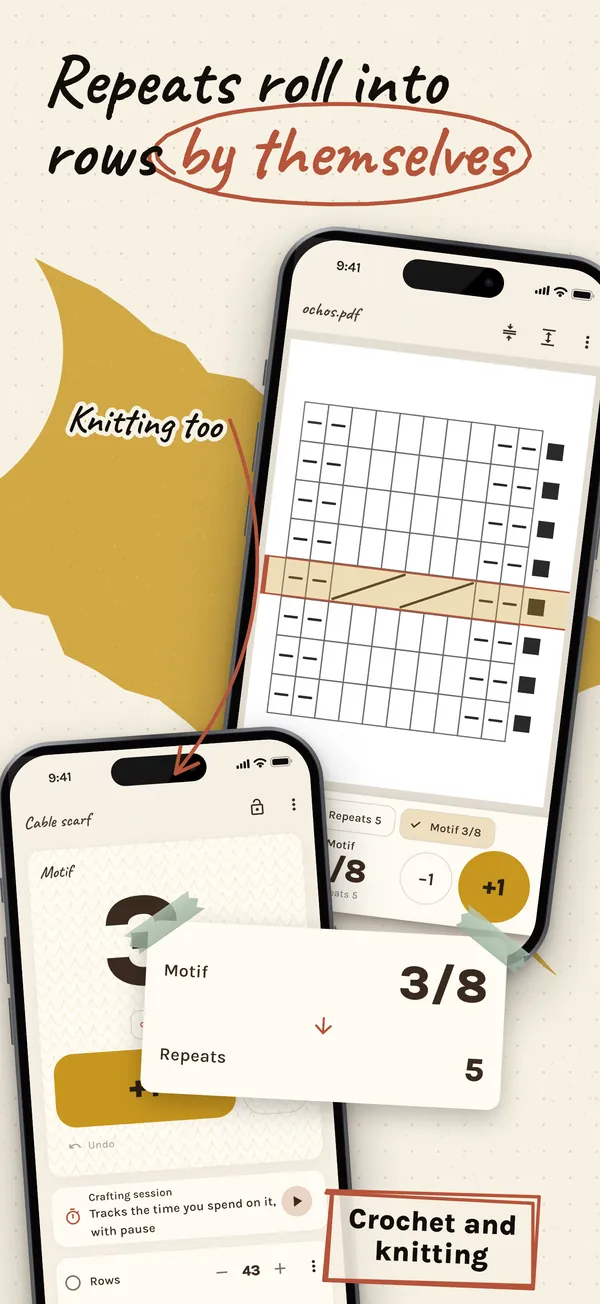
This works for any pattern with a fixed repeat: lace with a 12-row repeat, a mosaic stitch every 4 rows, or the decreases on a hat crown every other round.
A worked example: the cabled scarf
Here's how the two linked counters look across one evening on the scarf from the top of this article (8-row repeat, cable crossed on row 4):
| You just finished | Row in repeat | Repeats done | What the next row is |
|---|---|---|---|
| Row 41 of the scarf | 1 | 5 | Plain |
| Row 43 | 3 | 5 | The crossing row |
| Row 47 | 7 | 5 | Plain |
| Row 48 | 0 | 6 | Start of repeat 7 |
You only ever tapped one counter. The repeat number changed by itself on row 48, and the crossing row is always the row you start when the first counter shows 3.
Reading charts from the bottom up
Knitting charts start at the bottom right and are read upward: row 1 is the bottom line. Right-side rows usually read right to left and wrong-side rows left to right (worked flat), while in the round every row reads right to left.
That matters if you use a highlight or a ruler on the chart: it should climb one line each time you add a row, not drop like it would on a written crochet pattern. On a phone, a highlight band tied to the counter can do that for you, so the line you're on is always the one lit up.
Counting rows in the fabric
Every so often, check the counter against the knitting itself:
- Stockinette: each "V" stacked on the right side is one row. Count up a single column of Vs.
- Garter stitch: each ridge is two rows.
- Cables: count the rows between two crossings; it should match the repeat (7 plain rows and the crossing row, in an 8-row repeat).
A removable stitch marker hung every 10 rows makes recounting much faster.
Abbreviations, US and UK
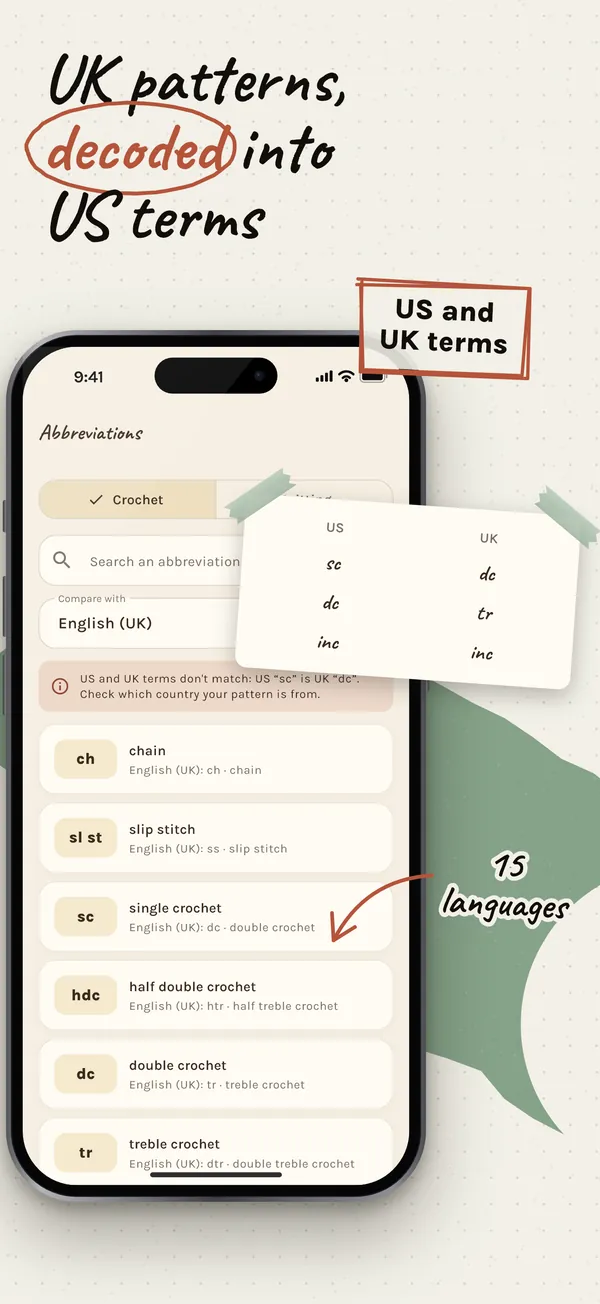
Knitting terms differ less between the US and the UK than crochet terms do, but some do differ: US bind off is UK cast off, US gauge is UK tension, and US stockinette is UK stocking stitch. Core abbreviations like k, p, k2tog and ssk are the same on both sides of the Atlantic.
Common knitting counting mistakes
- Counting the cast-on as row 1. Most patterns don't; check yours. Whatever you decide, stay consistent.
- Adding the row before it's finished. Add it right after the last stitch, never "almost done".
- Forgetting the wrong-side rows. If the chart only shows right-side rows, every chart row is really two rows of knitting. Note it on the project before you start.
- Trusting the counter blindly. Count the fabric every 10 rows.
FAQ
Is a knitting row counter different from a crochet one? The counting is the same. What changes is the vocabulary (rows rather than rounds, for flat work), the way charts are read, and the abbreviations.
Should the repeat counter start at 0 or 1? Either works, as long as you decide once. Starting at 0 makes "repeats done" read naturally: 5 means five finished.
Can I count without putting the needles down? With a counter on an Android phone that responds to the volume buttons, yes: a press on volume up adds the row while both hands stay on the needles.
The short version
For cables and lace, don't count total rows and divide. Link a row-in-repeat counter to a repeats counter, make your chart marker climb with each row, and check the fabric every 10 rows.