You've read the instructions: squeeze, hold, relax. You try it in the car and feel... something? Maybe? That doubt is so common that "am I doing Kegels right" shows up again and again in search suggestions. The good news: there are only a handful of signs to check.
The two-minute check
Do this lying on your back with your knees bent, or sitting in a chair with your feet flat. Put one hand on your belly. Then do three slow squeezes.
You're on track if:
- You feel a lift and a close, inward and upward. It's a small movement, not a push. Both Mayo Clinic and the NHS describe it as the muscles you'd use to hold in gas or stop yourself from peeing.
- The hand on your belly stays still. The NHS is specific about this: don't pull your tummy in.
- You keep breathing. If you can count out loud while you squeeze, you're breathing.
- Your buttocks and thighs stay loose. Clench them on purpose once so you know what that feels like, then make sure it isn't happening.
- When you let go, you feel the area drop and soften. Relaxing is half the exercise.
Something's off if:
- You feel pressure pushing down and out, like straining on the toilet. That's the opposite direction.
- Your belly hardens or your breath catches.
- You can only "feel it" when you squeeze your glutes hard.
- It hurts. Tired is normal for a new muscle; pain isn't.
About stopping your pee
The classic tip is to stop your urine mid-stream to find the muscle. It works as a one-time finder. Mayo Clinic advises against making a habit of starting and stopping your urine stream as an exercise, so once you know the feeling, do your Kegels with an empty bladder, anywhere else.
The mistakes that hide in plain sight
Holding your breath
It raises the pressure in your abdomen and bears down on the pelvic floor, which works against the squeeze. Breathe normally the whole time.
Never fully relaxing
People chain squeezes together without letting go, and the muscle stays tense. A simple rule: rest at least as long as you held.
Going for volume
Thirty sloppy squeezes do less than five good ones. When your thighs start to shake or your breath starts to hitch, you're done for that set.
Only ever doing long holds
Pelvic floor routines usually mix slow holds with quick squeezes that you let go of right away. The NHS describes both. How many of each is a question for your clinician.
Moving on from lying down
Once you can find the muscle every time lying down, try the same squeeze sitting in a chair, then standing. Each position is a little harder, because the muscles have more weight to hold up. Run the same checks in each one: belly still, breathing steady, glutes and thighs loose, a full release at the end. If the checks start failing when you stand, go back to sitting for a while. There's no rush.
A useful sign of progress isn't "I can do more"; it's "I can find it quickly, anywhere, without thinking about my breathing." That's when Kegels stop being an exercise you set time aside for and become something you can do while waiting for the kettle.
What if you feel nothing at all?
That happens, especially after childbirth, after prostate surgery or simply with age. Try lying down, go slowly, and do fewer reps. If after a few weeks you still can't tell whether anything is moving, that's exactly when a pelvic floor physical therapist is worth it. They can assess the muscles directly; an app can't.
Where an app helps, and where it doesn't
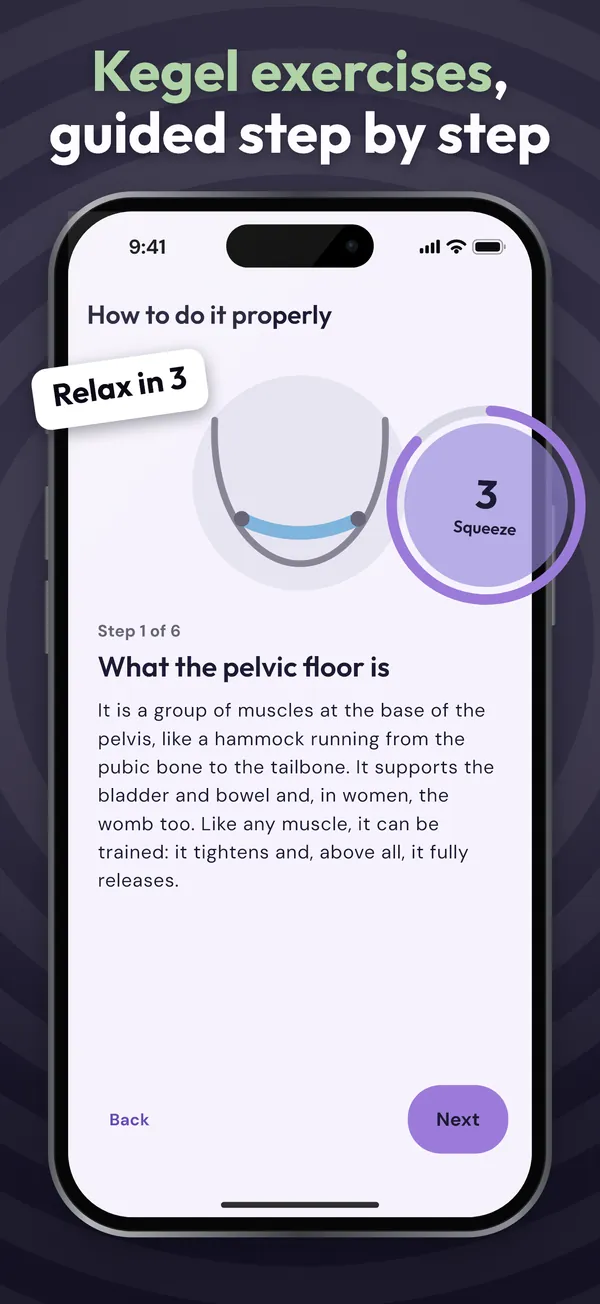
An app can't see your muscles. What it can do is make the good habits automatic. Ours, Kegel Exercises & Postpartum, is built around the checks above:
- A six-step guide before the first session: what the pelvic floor is, how to find it, what you should feel, common mistakes, letting go fully and when to see someone. Then three guided practice squeezes.
- A 3-2-1 countdown before every switch between squeeze and relax, so you're never caught mid-breath.
- A different vibration for squeeze and relax, and an optional voice that says each step.
- Four exercise types: long holds, quick squeezes, the "elevator" (squeezing in stages) and relaxation, which is just breathing and letting go.
It doesn't measure strength or tell you you're doing it right. For that, you need a person.
Keep reading
Wondering when you'll notice anything? Read how long Kegels take to work. Comparing apps? The Kegel app comparison lists what each one charges. Ours has its own page.