Search an app store for "blood pressure" and you'll find apps that show a finger pressed against a phone camera, with names like "Measure BP & HR" and screenshots full of numbers. It's a fair question whether that works. The answer from the people who write the guidelines is consistent: not well enough to rely on.
What the heart associations say
- American Heart Association, home monitoring guidance: use "an automatic, cuff-style, upper arm (biceps) monitor." Wrist and finger monitors are not recommended because they're less accurate. Choose a validated monitor.
- 2025 AHA/ACC high blood pressure guideline: cuffless devices, smartwatches included, are not recommended for diagnosing or managing high blood pressure, because their accuracy and validation still fall short.
- European Society of Hypertension, 2021 measurement guidelines: for home monitoring, they don't recommend wrist devices, finger-cuff devices, wearable bands or other cuffless devices.
That's three major bodies, on both sides of the Atlantic, saying the same thing.
So what do the finger-on-camera apps measure?
The camera and flash can see tiny changes in the color of your fingertip as blood pulses through it. That signal is good for counting your pulse. Blood pressure is a different quantity: the force of blood against your artery walls, which a cuff measures by squeezing the artery and releasing it. Estimating pressure from a pulse signal requires assumptions that may not hold for you on a given day.
When we tested the most installed blood pressure app on Google Play (50M+ installs) on November 15, 2026, its onboarding spent a screen on "measuring" blood pressure from your fingertip. What it produced was a heart rate in beats per minute.
What about smartwatches?
Some watches now offer blood pressure features: some need regular calibration against a cuff, and others don't show a number at all but notify you of possible high blood pressure so you can check with a cuff. Those are different from an app on your phone's camera, and some have gone through regulatory review for what they claim. But even so, the 2025 AHA/ACC guideline doesn't recommend cuffless devices for diagnosis or management. If your watch flags something, treat it as a reason to measure properly with a cuff and talk to your doctor, not as a reading.
Why accuracy matters more than it seems
Blood pressure decisions turn on small differences. The line between categories is often 10 mmHg or less, and home averages are compared with thresholds like 130/80 (AHA/ACC) or 135/85 (European guidelines). A device that's off by a few points can put you on the wrong side of a line, either worrying you for nothing or reassuring you when it shouldn't.
Apps that read your monitor's screen are a different thing
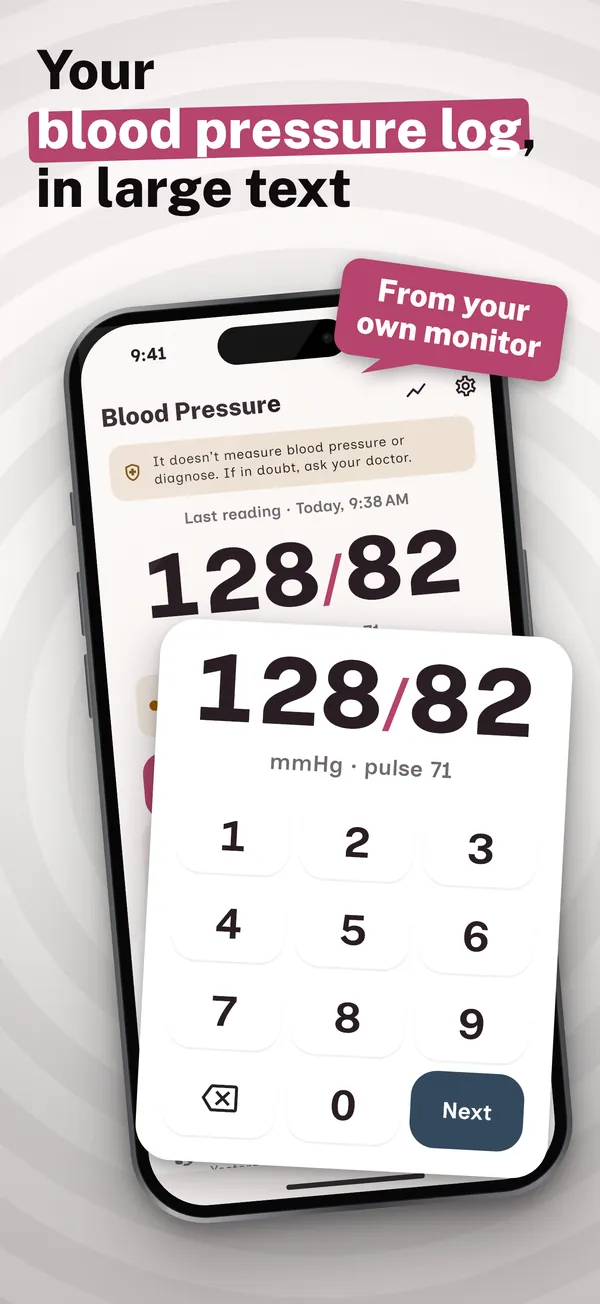
Some apps use the camera in another way: you point the phone at your cuff's display and the app reads the three numbers off the screen, like a scanner. That isn't measuring. The cuff did the measuring; the app is just saving you the typing. Whether it's worth it depends on how reliably it reads your model of monitor, so always check the numbers it fills in before you save them. Ours doesn't offer this in its current version; you type the reading with large keys.
What to use instead
- A validated, automatic upper-arm cuff. In the US, validatebp.org lists devices that have been checked. Make sure the cuff size fits your arm.
- The right routine. The AHA's checklist: no smoking, caffeine or exercise for 30 minutes before; five minutes of quiet rest; back supported, feet flat, arm resting at heart level; cuff on bare skin; two readings one minute apart; the same time each day.
- A log. Write down every reading, or let an app keep it, and bring it to your appointment. Ask your clinician to check your monitor against theirs about once a year.
How a phone actually helps
A phone is good at the parts people struggle with: remembering, writing things down, doing the math. That's what our app does, and it says so on its first screen:
- You log what your cuff shows with large keys, plus arm and position if you like.
- A guided 7-day check: morning and evening, two readings with a one-minute countdown, then morning, evening and overall averages. Free.
- A one-page PDF of that week for your appointment. Free.
- Your home reference value with its source, AHA/ACC 2025 by default in the US, and your doctor's target if you enter it. No "stage" labels on single readings.
- Reminders for readings and medication (no doses stored), no account and no ads.
It doesn't read the monitor's screen with the camera in this version and it doesn't connect over Bluetooth. You type the three numbers.
Keep reading
Starting a home log? See how to keep a blood pressure log sheet your doctor can use. Comparing apps? Our Android blood pressure app comparison tests what each one lets you hand your doctor. Our app's page has screenshots.